
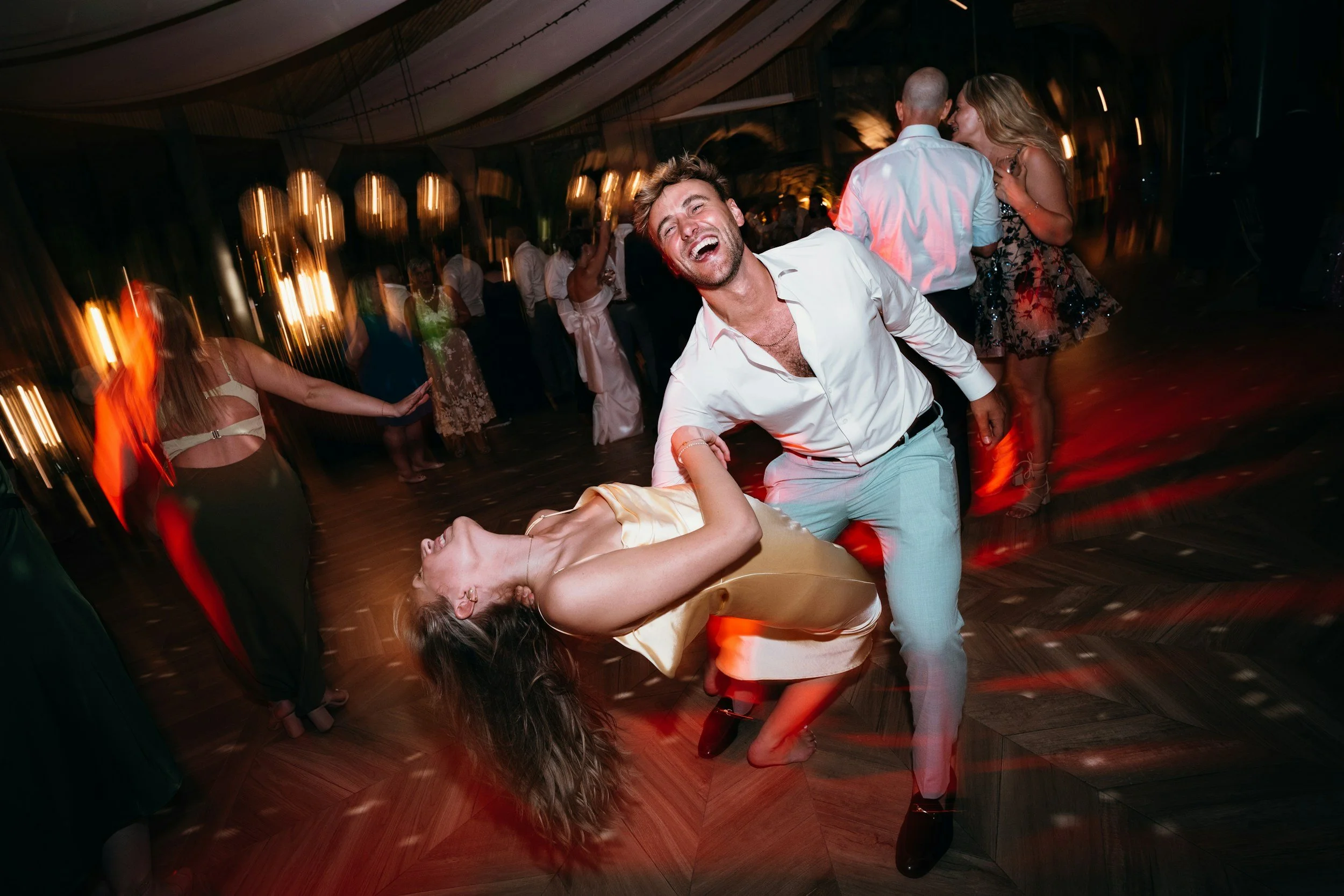
The best wedding dance floors don't happen because someone pressed play on the right playlist. Here's how great music, thoughtful planning, and a little experience come together to create an unforgettable night.
You know the kind of wedding we're talking about.
Dinner is over. The formalities are finished. The DJ starts playing, and suddenly everyone's on the dance floor.
Your friends are singing along.
Your parents are dancing with people they met an hour ago.
Someone's grandmother is having the time of her life.
And every time you think about stepping away for a drink, another song comes on that pulls you right back.
Those are some of our favorite weddings.
Not because every celebration needs to turn into the biggest party imaginable.
But because there's something pretty incredible about seeing people come together through music.
And when it happens naturally, it creates the kind of memories people talk about for years.
So how do you make that happen at your wedding?
Here's what we've learned.
1. Start with your music, not a list of popular wedding songs
Let's get something out of the way.
There's nothing wrong with popular wedding songs.
They're popular for a reason.
Some songs have an incredible ability to get people singing, dancing, and celebrating together.
But we don't believe your wedding should sound exactly like every other wedding.
And that starts with understanding what makes your music personal.
Maybe you and your partner grew up listening to completely different genres.
Maybe there's an artist you've seen together a dozen times.
Maybe your college friends have a song that immediately brings back memories.
Or maybe there's a song your entire family knows because it's been played at every celebration for as long as you can remember.
We want to know those things.
At Move DJ Group, our planning process includes conversations about your favorite artists, musical preferences, and the songs that mean something to you.
But we're not simply collecting a playlist.
We're learning about the people behind it.
Because when your DJ understands your musical identity, they can create something much more personal than a collection of popular songs.
Our advice: Before making a wedding playlist, think about the music that tells your story.
Not every song needs to be meaningful.
Some are there because they're fun.
But the overall experience should feel like yours.
2. Think about who's actually coming to your wedding
Here's where wedding music gets interesting.
You're not planning a party for a group of people who all have the same musical taste.
You're bringing together friends, family, coworkers, and people from different generations.
Your college friends might love hip-hop.
Your parents might be looking forward to some classic rock.
Your grandparents might light up when they hear Motown.
And somewhere in the middle is a group of people who will happily dance to almost anything.
That's part of what makes weddings unique.
And part of what makes DJing them so much fun.
The challenge isn't finding one genre everyone loves.
It's creating an experience where different groups of people feel included.
You don't have to please everyone with every song
In fact, we'd encourage you not to try.
A great wedding DJ understands that the energy of the room changes throughout the evening.
Sometimes a familiar classic brings multiple generations together.
Sometimes a modern hit gets your friends moving.
Other times, the right throwback makes people who haven't danced all night suddenly head toward the floor.
It's about understanding who's in the room and finding opportunities to bring them together.
That's why we ask couples about their guests during the planning process.
Are most of your guests in their twenties and thirties?
Is it a multigenerational crowd?
Are there family traditions or cultural influences we should understand?
Those details help us prepare.
And they help us create a celebration that feels welcoming to everyone without losing sight of the two people we're there to celebrate.
3. A packed dance floor is about momentum
Here's something that separates an experienced DJ from a great playlist.
Knowing what to play next.
Let's say the dance floor is packed.
Everyone's singing along, the energy is great, and people are having an incredible time.
The song ends.
What happens next?
You could play another popular song.
And maybe it works.
But the right choice involves more than popularity.
A DJ is thinking about the tempo, the energy, the musical style, and how people are responding.
Does the next song build on the momentum?
Does it introduce a different genre without making the transition feel awkward?
Is it time to shift the energy slightly?
Or should we stay right where we are because the room is loving it?
Those decisions happen throughout the night.
And they're not always obvious.
It's not only about which songs you play
The transitions matter, too.
A smooth transition can help two very different songs feel like they belong together.
A thoughtful remix can introduce something familiar in an unexpected way.
Even the timing of a song can make a difference.
Sometimes you want to let everyone sing through the entire chorus.
Other times, moving into the next song at the right moment keeps the energy from fading.
Jacob Brinkerhoff brings a background in music theory and composition to his approach.
Nik Lizcano draws from his experience with songwriting, remixes, and live performance.
Derick Castillo brings an appreciation for different musical styles and how they connect people.
Each approaches music differently.
But they share an understanding that a great reception requires more than pressing play.
It's about building an experience.
And knowing how to keep it moving.
4. Trust your DJ to read the room
You can spend months creating an incredible playlist.
And we think you should absolutely share that music with your DJ.
But here's something worth remembering.
You don't know exactly how your guests are going to respond until they're there.
Maybe a song you thought would be a huge hit doesn't get the reaction you expected.
Maybe a song you hadn't considered brings everyone onto the dance floor.
It happens.
And that's where experience makes a difference.
A great DJ pays attention.
They're watching how guests respond.
Noticing who's dancing.
Recognizing when the energy starts to change.
And making adjustments along the way.
What does reading the room actually mean?
It doesn't mean ignoring your music preferences and playing whatever the DJ wants.
It means using those preferences as a foundation while responding to the people celebrating with you.
Imagine you've asked for a mix of early 2000s hip-hop, modern pop, and classic dance songs.
The dance floor opens, and your guests respond especially well to the throwbacks.
An experienced DJ recognizes that.
Maybe they spend a little more time in that musical space before transitioning into something else.
Or maybe the next song brings in a different generation without losing the people already dancing.
That's reading the room.
It's also why we'd encourage couples to have an honest conversation about how much flexibility they want their DJ to have.
Some couples have very specific musical preferences.
Others are comfortable giving their DJ more creative freedom.
Both approaches can work.
The important thing is communicating those expectations ahead of time.
Our advice: Give your DJ a clear picture of what you love, what you want to avoid, and where you're comfortable letting them make decisions.
That balance helps create a celebration that's personal and responsive.
5. Your must-play list should be intentional
We love a good must-play list.
It's one of the easiest ways to understand a couple's musical tastes.
But we'd encourage you to be thoughtful about what goes on it.
If you give your DJ a list of 100 songs that absolutely must be played, you may unintentionally limit their ability to respond to the room.
And depending on how much time you've reserved for dancing, you might not have enough time to play them all.
Instead, consider organizing your music into three categories.
Must-play songs
These are the songs you absolutely want to hear.
Maybe they're meaningful to your relationship.
Maybe they're favorites among your closest friends.
Or maybe you simply can't imagine your wedding without them.
Make sure your DJ knows which ones matter most.
Songs and artists you love
This is where you can have some fun.
Share your Spotify playlists.
Talk about your favorite genres.
Include songs that capture the overall atmosphere you're hoping to create.
These give your DJ a sense of your musical personality without requiring every song to make the final set.
Do-not-play songs
Equally important.
If there's a song, artist, or genre you don't want played at your wedding, tell your DJ.
You don't need to explain why.
Maybe you're tired of hearing it.
Maybe it brings back a memory you'd rather avoid.
Or maybe it simply doesn't fit the celebration you're planning.
That's enough.
At Move, our planning guide includes space for must-play songs, music preferences, and what we call blacklisted music.
We want couples to feel comfortable being specific.
Because the more we understand your preferences, the better we can create an experience that feels like you.
6. Plan the evening so dancing has room to happen
Here's something couples don't always consider when building their wedding timeline.
Even the best DJ can't create a packed dance floor if there's barely any time left for dancing.
Think about everything you might want to include in your reception.
Introductions.
Dinner.
Toasts.
First dances.
Parent dances.
Cake cutting.
Special family traditions.
Maybe a game or two.
All of those moments can be meaningful.
But they take time.
And if they're spread throughout the evening, they can interrupt the momentum you're trying to build.
Give the dance floor time to find its rhythm
We generally encourage couples who prioritize dancing to protect at least 90 minutes to two hours of open dancing, preferably more when the schedule allows.
That's a planning recommendation, not a fixed requirement.
Some weddings naturally have longer dance sets.
Others are centered more around dinner, conversation, or other experiences.
What matters is understanding your priorities.
If a packed dance floor is high on your list, make that part of the plan.
And once the dance floor opens, think carefully about how often you want to stop it.
Every interruption asks your guests to shift their attention.
Sometimes that's necessary.
But sometimes it's worth grouping important moments earlier in the evening so the celebration can continue naturally.
We've covered this in more detail in our [Wedding Reception Timeline Guide](/guides/wedding-reception-timeline).
A little thoughtful planning can make a big difference.
7. The couple sets the tone more than they realize
This might be one of our favorite pieces of advice.
If you want your guests to dance, spend some time on the dance floor yourselves.
Think about it.
Your friends and family came to celebrate you.
They're excited to spend time with you.
And when they see you enjoying yourselves, there's a good chance they'll want to be part of it.
We're not saying you need to dance all night.
And we're certainly not suggesting you should feel pressured to do something that makes you uncomfortable.
It's your wedding.
But if having an incredible dance party is part of your vision, don't underestimate the energy you bring to the room.
Sometimes the moment that really gets everyone moving isn't a particular song.
It's seeing the couple step onto the dance floor with their closest friends.
Suddenly, people want to join.
And before long, there's a celebration happening that nobody wants to miss.
What if we aren't big dancers?
That's completely fine.
Not every couple loves being on the dance floor.
And not every wedding needs to revolve around dancing.
Maybe you're more interested in creating an incredible atmosphere where people can relax, connect, and enjoy the music.
We love that, too.
The goal isn't to force a particular kind of celebration.
It's to create the one that's right for you.
A great DJ should be able to help with either.
8. Don't forget the music outside the dance floor
When couples think about wedding entertainment, it's easy to focus on the dancing.
But music plays a role in almost every part of the day.
The ceremony.
Cocktail hour.
Dinner.
Introductions.
Special dances.
Even the final moments before everyone heads home.
Each part of the celebration has a different purpose.
And the music should reflect that.
Ceremony music
These are some of the most meaningful songs of the day.
You might choose something traditional, something contemporary, or a song that has a personal connection to your relationship.
The goal is to complement the moment.
Cocktail hour
We love using cocktail hour to establish the atmosphere.
Maybe it's relaxed.
Maybe it's upbeat.
Maybe it's a great opportunity to feature music you love but wouldn't necessarily want during open dancing.
Dinner
Dinner music should create an inviting atmosphere without making conversation difficult.
It's another chance to incorporate your personality into the celebration.
Open dancing
This is where the energy shifts.
Your DJ begins building momentum, responding to guests, and bringing different musical influences together.
Last dance
And finally, there's the last song.
Maybe it's a big celebration with everyone together.
Maybe it's something emotional.
Maybe it's a song you've been looking forward to all night.
Whatever you choose, we'd encourage you to make it intentional.
Because music isn't only there to fill the space between the important moments.
Sometimes, it helps create them.
9. Song requests: Should your DJ take them?
This comes up pretty often.
And our answer is simple.
It depends on what you want.
Some couples love the idea of guests making requests.
Others prefer a more curated musical experience.
Neither approach is wrong.
What's important is establishing expectations before your wedding.
At Move, our planning guide gives couples several options.
You can ask your DJ to avoid requests entirely.
You can welcome requests from everyone.
Or you can allow your DJ to filter requests based on your preferences and the atmosphere of the evening.
We often think that last approach gives couples a nice balance.
Guests can participate, but the DJ still has the flexibility to determine whether a request fits the celebration.
Because let's be fair.
Not every requested song is the right song for that moment.
Your DJ should be comfortable making those decisions while respecting the boundaries you've established.
And one more thing worth discussing?
Clean versus explicit music.
If you're planning a celebration with lots of families and younger guests, you may prefer clean versions throughout the evening.
Other couples are comfortable with different guidelines later in the night.
It's worth having that conversation ahead of time so your DJ understands your expectations.
5 practical tips for a great wedding dance floor
If you're currently planning your reception, here's where we'd start.
1. Share music that represents you.
Give your DJ a sense of your favorite artists, genres, and songs. Don't worry about building the perfect playlist.
2. Be clear about your must-plays and do-not-plays.
Let your DJ know which songs matter most and which ones should stay off the playlist.
3. Consider the people you're celebrating with.
Think about the different generations, personalities, and musical tastes in the room.
4. Protect enough time for dancing.
Build your reception timeline around the experiences you care about most.
5. Choose someone you trust to read the room.
Great wedding entertainment requires preparation, musical knowledge, and the confidence to make thoughtful decisions throughout the night.
And if you're still looking for the right person, our guide to [Choosing the Right Wedding DJ for Your Personality](/guides/how-to-choose-the-right-wedding-dj) is a great place to start.
Frequently asked questions about wedding dance floor music
How do you keep guests dancing at a wedding?
Start with a thoughtful reception timeline, music that reflects the couple and their guests, and an experienced DJ who knows how to read the room. Smooth transitions, familiar songs, and the right pacing can help maintain energy throughout the evening.
What music gets people dancing at weddings?
There's no single playlist that works for every wedding. Familiar songs, throwbacks, and music that connects with different generations can be effective, but the best selections depend on the couple's preferences and the guests in attendance.
Should we give our wedding DJ a playlist?
Absolutely. Sharing playlists is a great way to communicate your musical preferences. We'd recommend identifying a smaller group of must-play songs while giving your DJ enough flexibility to respond to the room.
How many songs should be on our wedding playlist?
That depends on your reception length and how much time you've reserved for dancing. As a rough planning estimate, two hours of dancing might accommodate approximately 30 to 50 songs, depending on how long each song is played and how the DJ mixes them.
You don't need to choose every song in advance.
Should wedding DJs take song requests?
That depends on your preferences. Some couples welcome requests, while others prefer a curated playlist. You can also ask your DJ to filter requests based on your approved music and the energy of the room.
How much time should we allow for wedding dancing?
If dancing is a major priority, we recommend planning for at least 90 minutes to two hours of open dancing, with more time when possible. Your reception timeline should reflect the experiences that matter most to you.
Can a wedding DJ mix different music genres?
Yes. Experienced DJs often use transitions, pacing, and musical knowledge to move between genres while keeping the celebration feeling natural. This is especially useful at weddings with guests from different generations and musical backgrounds.
The best wedding dance floor feels like you
Here's what we hope you'll remember.
An incredible wedding dance floor isn't necessarily the one with the most people dancing every second of the night.
It's the one where the music feels right.
Where your friends recognize the songs you love.
Where your family feels part of the celebration.
Where people who might not have much in common find themselves singing and dancing together.
And where you can look around the room and think, This is exactly what we hoped our wedding would feel like.
That's what we're working toward.
At Move DJ Group, we love music.
We love great transitions, unexpected song combinations, and watching a room come alive.
But what we love even more is creating an experience that feels personal to the people we're celebrating.
Because at the end of the night, it's not about how many songs we played.
It's about the memories you made.
And if we did our job well, there might be a few songs you never hear quite the same way again.
That's what makes a great wedding.
If you're planning a wedding in Nashville, Franklin, Middle Tennessee, or the greater Kansas City area, we'd love to hear about what you have in mind.
Get to know our DJs, explore their different musical backgrounds, and find someone who feels like the right fit.